What Really Shapes a Customer’s Vehicle Buying Power?
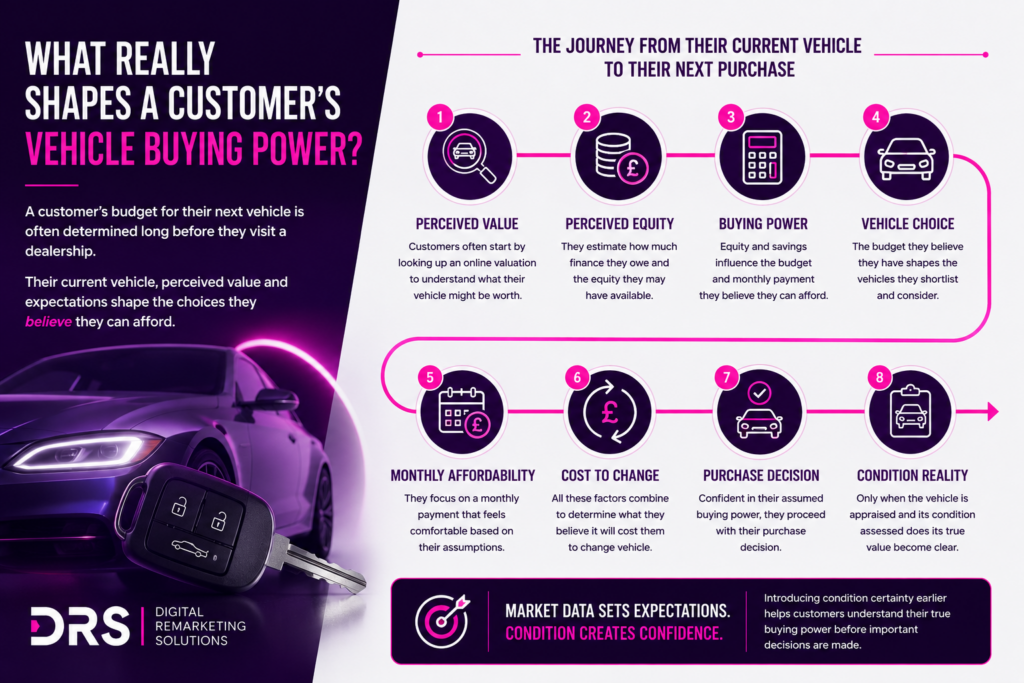
Why your current vehicle often determines the next one you believe you can afford.
Every day, thousands of customers begin searching for their next vehicle.
They browse Auto Trader, Motors, CarGurus, manufacturer websites and retailer stock, often filtering their search by maximum price or monthly payment.
It feels like a simple decision.
“This is my budget.”
But have you ever stopped to ask what actually shaped that budget in the first place?
Most people assume it’s determined by income, savings or how much they’re prepared to spend each month.
In reality, one of the biggest influences isn’t the next vehicle at all.
It’s the one already sitting on the customer’s driveway.
Customers Don’t Just Buy Vehicles… They Buy What They Believe They Can Afford
When customers start looking for their next vehicle, they rarely begin with the list price.
Instead, they subconsciously calculate what they believe they can afford.
Questions such as:
- What is my current vehicle worth?
- Do I still owe finance?
- How much equity do I have?
- How much deposit could I put into my next vehicle?
- What monthly payment feels comfortable?
Together, these answers shape the customer’s buying power before they’ve even visited a dealership.
In other words, customers don’t simply choose the next vehicle they can afford.
They choose the next vehicle they believe they can afford.
Online Valuations Are Quietly Shaping Customer Expectations
Today’s customer journey often begins with an online vehicle valuation.
Whether they’re exploring a Sell My Car service, researching a part exchange valuation, or simply trying to understand what their current vehicle might be worth, customers increasingly rely on online valuation tools before contacting a retailer.
These platforms provide an important service by using market data to produce an indicative value.
However, many customers understandably interpret that figure as the amount their vehicle is actually worth.
That valuation then becomes much more than a simple guide.
It often influences:
- the budget they set,
- the vehicles they shortlist,
- the monthly payments they believe are achievable,
- and ultimately whether they think changing vehicle is financially possible.
The important point is that this expectation is usually established before anyone has assessed the vehicle’s actual condition.
Perception Before Certainty
This is where customer psychology becomes particularly interesting.
A customer’s buying power is often built around perception rather than certainty.
If they believe their current vehicle is worth £10,000, they’ll naturally search for a different range of vehicles than someone who believes theirs is worth £6,000.
The current vehicle quietly influences the replacement vehicle long before any retailer becomes involved.
The customer’s shortlist has already been created.
Their expectations have already been formed.
Their affordability has already been calculated.
All before anyone has actually seen the vehicle.
The Missing Ingredient: Condition Certainty
The automotive industry has become very good at helping customers understand what their vehicle might be worth.
Online vehicle valuations, market data and pricing algorithms have made obtaining an indicative value easier than ever.
However, market data is only one part of the equation.
The missing ingredient is condition.
Until a vehicle has been professionally assessed, no one can accurately determine its true market value or acquisition value.
A vehicle with excellent condition may exceed expectations.
A vehicle with significant cosmetic or mechanical issues may be worth considerably less.
Neither outcome is wrong.
They’re simply the result of moving from assumption to certainty.
Market data sets expectations. Condition creates confidence.
Why This Matters
Condition doesn’t simply influence the value of the customer’s current vehicle.
It influences their buying power.
If customers build their replacement budget around an indicative market valuation alone, they may unknowingly be basing their next vehicle choice on an assumption rather than reality.
When the vehicle is eventually appraised and condition is taken into account, it’s not just the valuation that changes.
The customer’s perceived buying power changes.
Their monthly affordability changes.
Their cost to change changes.
Sometimes their vehicle choice changes too.
This is often where friction enters the customer journey—not because either party is wrong, but because expectations were established before condition certainty existed.
A Different Way of Thinking
Perhaps the industry has become focused on answering the wrong question.
Instead of asking:
“What is this customer’s vehicle worth?”
Perhaps we should first ask:
“How can we establish a realistic expectation of its value before it shapes every decision that follows?”
The earlier condition certainty can be introduced into the customer journey, the earlier customers can understand their true buying power.
That creates more informed decisions.
More realistic expectations.
Better quality conversations.
And ultimately, greater confidence for both the customer and the retailer.
Final Thoughts
For years, automotive retail has focused on helping customers choose their next vehicle.
Perhaps the bigger opportunity is helping customers understand what they can genuinely afford before they ever start searching.
Because a customer’s current vehicle doesn’t simply influence the deal they eventually complete.
It influences the budget they set.
The vehicles they shortlist.
The monthly payments they expect.
And ultimately, whether they believe changing vehicle is even possible.
Maybe the first vehicle in every replacement journey isn’t the next one at all.
It’s the one they’re already driving.
If you’d like to see how condition-led self-appraisal can support part-exchange conversion and help you retain more acquisition opportunities, we’d be happy to show you how the DRS platform works.