Where Does Your Sell Your Car Enquiry Go Next?
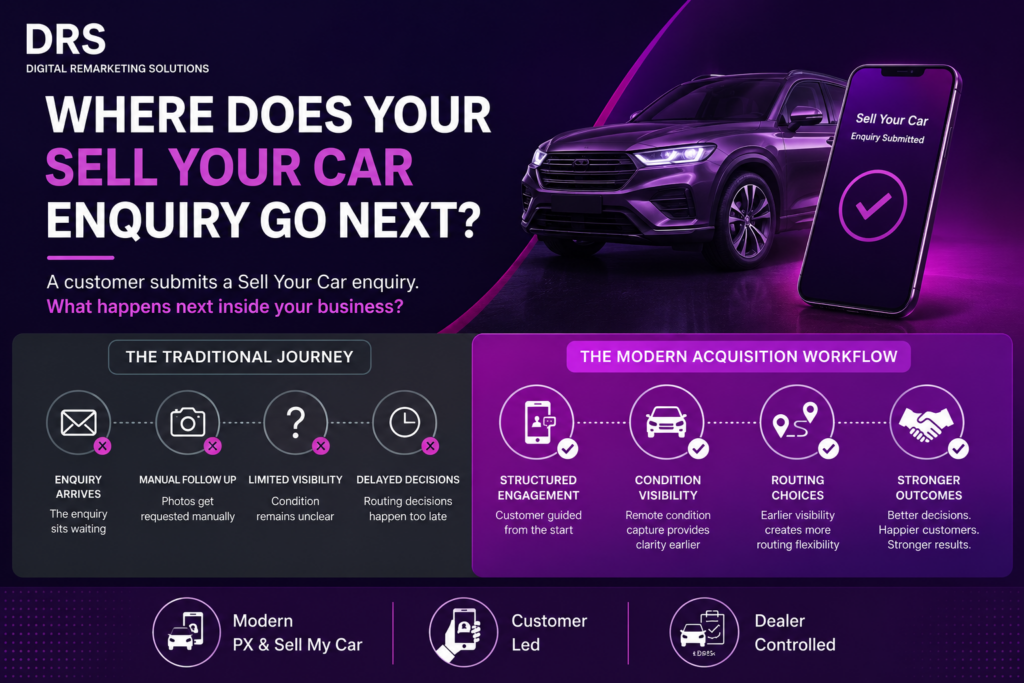
A customer submits a Sell Your Car enquiry.
For many retailers, that moment feels like the start of a valuation exercise.
But increasingly, it is becoming something much bigger:
the start of an acquisition workflow.
The challenge is not generating the enquiry.
Most dealer websites, marketplaces and digital campaigns already create opportunities.
The bigger question is what happens next.
The hidden operational gap
A customer submits a Sell Your Car or Part Exchange enquiry.
But not every vehicle naturally fits a retailer’s preferred stock profile.
Some may have:
• Higher mileage
• Multiple owners
• Age profile challenges
• Cosmetic condition considerations
• Stock mix constraints
For many retailers, the instinct is simply to decline the acquisition opportunity.
But that can create an unintended consequence.
When a customer is trying to purchase another vehicle, disposing of their existing vehicle is often part of progressing the retail conversation.
Customers still want confidence they are achieving fair market value.
If retailers stop supporting that journey entirely, they risk losing more than the vehicle.
They can lose:
• The customer relationship
• Control of the conversation
• Margin opportunity
• And ultimately the retail transaction itself
That is why modern acquisition workflows are becoming less focused on “buy or decline” decisions.
Instead, they create more flexibility around what happens after the enquiry arrives.
Customer enquires
→ Condition visibility introduced earlier
→ Internal decision-making improves
→ Vehicles assessed against retail profile
→ Alternative acquisition and disposal options considered
→ Retail conversations continue
Routing does not always mean buying the vehicle internally.
Sometimes the better commercial outcome is creating additional exposure.
That could include:
• Publishing the vehicle to a wider audience
• Offering alternative acquisition routes
• Sharing opportunities internally across sites or buyers
• Creating trade or wholesale visibility
• Supporting downstream disposal decisions
The objective is not simply retaining every vehicle.
It is retaining more customers, creating more options and improving the chances of progressing the retail deal.
Rejecting the vehicle should not automatically mean losing the customer.
Modern acquisition starts earlier
The strongest acquisition journeys increasingly introduce structure earlier.
Not to remove human interaction.
But to improve the quality of the conversation.
That means:
• engaging customers earlier
• capturing vehicle condition earlier
• improving acquisition visibility
• supporting internal underwrite decisions
• creating more flexible routing outcomes
The objective is not simply generating more valuations.
It is creating a stronger process around what happens after the enquiry arrives.
Moving from assumption-led to condition-led decisions
For years, valuation has often happened before condition visibility.
That creates friction.
Modern workflows are beginning to reverse that order.
Condition first.
Decision second.
This allows retailers to:
• Improve valuation confidence
• Maintain customer engagement
• Reduce unnecessary operational cost
• Retain more control of the sales funnel
• Create stronger acquisition outcomes
The bigger opportunity
Sell Your Car and Part Exchange journeys are becoming more than lead generation tools.
They are increasingly becoming operational infrastructure that influences acquisition, routing and customer retention.
The question is no longer:
“How many enquiries did we generate?”
It is becoming:
“What did our process allow us to do with them?”
—
Digital Remarketing Solutions (DRS)
Modern PX & Sell Your Car Infrastructure
Customer Led | Dealer Controlled