Why Vehicle Valuation Alone Doesn’t Decide Modern Part Exchange and Sell My Car Journeys
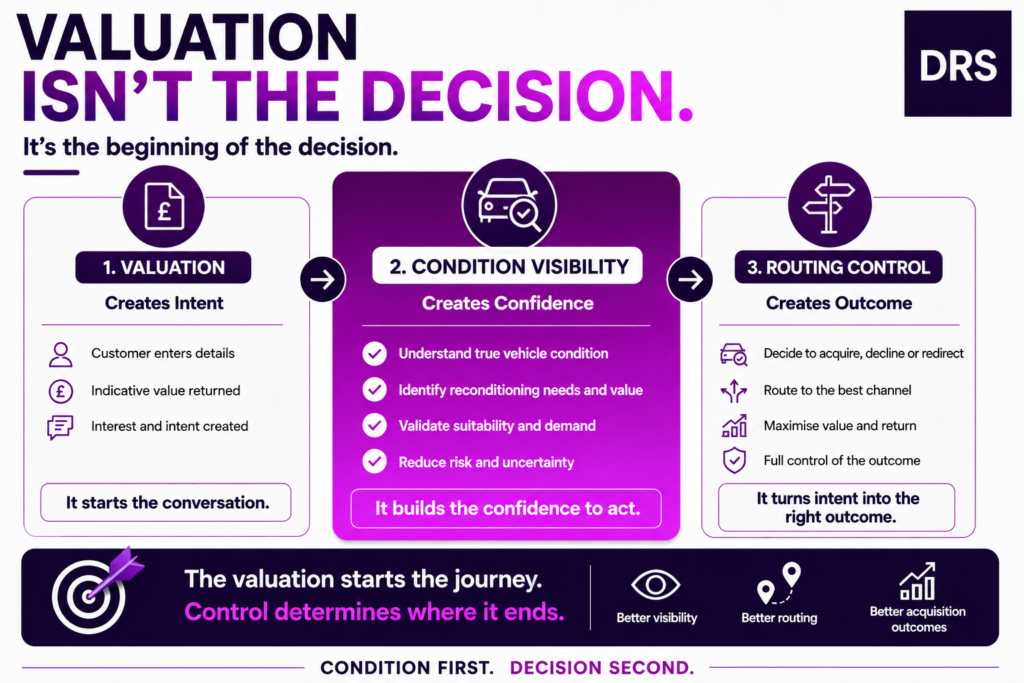
Why Vehicle Valuation Alone Doesn’t Decide Modern Part Exchange and Sell My Car Journeys
One of the most common questions in Part Exchange, Sell My Car and online vehicle valuation journeys is:
“What’s my car worth?”
And in many cases…
the valuation becomes the decision.
But not always for the reasons we think.
For Consumers, Valuation Often Creates The Decision
Customers don’t usually begin by deciding to dispose of their vehicle.
They start by exploring possibility.
Could I afford to change?
Would a retailer want my car?
Is it worth continuing?
That’s why vehicle valuation matters.
Because the number creates emotion.
Too high?
It becomes the benchmark.
The customer compares every future conversation against it.
Expectation rises.
Competition increases.
The retailer now has to justify why their valuation differs.
Too low?
The customer disengages.
They assume the vehicle isn’t desirable.
They abandon the journey.
They go elsewhere.
So from a consumer perspective…
the valuation can absolutely become the decision.
Continue.
Pause.
Leave.
Engage.
Vehicle valuation influences all of it.
But For Retailers, Valuation Should Only Start The Decision
For retailers and dealer groups, the number alone tells you very little.
A Part Exchange valuation doesn’t tell you:
Can we acquire this vehicle?
What condition is it in?
Does it fit our stock profile?
What preparation might it need?
Should we retail it?
Should we trade it?
Should we route it differently?
Those decisions only become possible once more information becomes visible.
The Consumer Wants Speed. The Retailer Wants Certainty
Most customers now begin their vehicle journey online.
They expect immediate engagement.
Immediate answers.
Immediate valuation.
That expectation makes sense.
Digital retail has conditioned customers to move quickly.
But retailers face a different challenge.
They don’t just need a valuation.
They need to understand condition.
Because condition influences:
Suitability.
Preparation.
Margin.
Routing.
Risk.
Traditionally, retailers solved this by asking customers to visit the dealership.
But consumers increasingly expect confidence before making that effort.
That creates a tension.
Consumers want an answer before inspection.
Retailers want inspection before commitment.
The opportunity may not be choosing one over the other.
It may be creating journeys that progressively improve certainty before physical handover.
Valuation starts engagement.
Condition visibility builds confidence.
Routing creates outcomes.
Confidence Is Built In Layers
Once vehicle condition becomes visible, the conversation changes.
Retailers move beyond indicative values.
Customers gain confidence that expectations are grounded.
Preparation becomes clearer.
Routing becomes possible.
But confidence doesn’t come from condition alone.
Confidence is created when multiple layers strengthen together.
Financial Confidence
Can I afford to change my vehicle?
Affordability.
Eligibility.
Finance position.
PX Confidence
What is my vehicle realistically worth based on evidence rather than assumption?
Condition visibility.
Condition-based valuation confidence.
Equity position.
PX Routing Confidence
If acquired, where does the vehicle go next?
Retail stock.
Internal transfer.
Direct-to-trade.
Underwrite.
Alternative disposal.
Commercial Confidence
Does the transaction work commercially for the retailer?
Dealer appetite.
Landed cost.
Total deal economics.
When those layers strengthen together, something more valuable starts to happen.
Decision confidence.
The point where both customer and retailer feel comfortable committing to the transaction.
And stronger decision confidence can create stronger outcome confidence.
Fewer transactions needing to be renegotiated later in the journey.
Better alignment of expectations.
A higher proportion progressing through to completion.
Routing Control Creates Outcomes
Once vehicle condition becomes visible, decisions become possible.
Acquire.
Retail.
Trade.
Redirect.
Wait.
This creates stronger stock acquisition decisions and more flexible vehicle routing outcomes.
Because different vehicles create different opportunities.
Some belong in retail.
Some fit wholesale channels.
Some create stronger outcomes elsewhere.
Routing control creates optionality.
Routing creates outcomes.
Final Thought
Maybe vehicle valuation isn’t the wrong answer.
Maybe we’ve simply been asking too much of it.
For customers, valuation may create the decision.
For retailers, it should begin the decision.
The valuation starts the journey.
Control determines where it ends.
Condition first. Decision second.
If you’d like to see how condition-led self-appraisal can support part-exchange conversion and help you retain more acquisition opportunities, we’d be happy to show you how the DRS platform works.