Why Part Exchange Performance Isn’t Measured by Valuation Volume
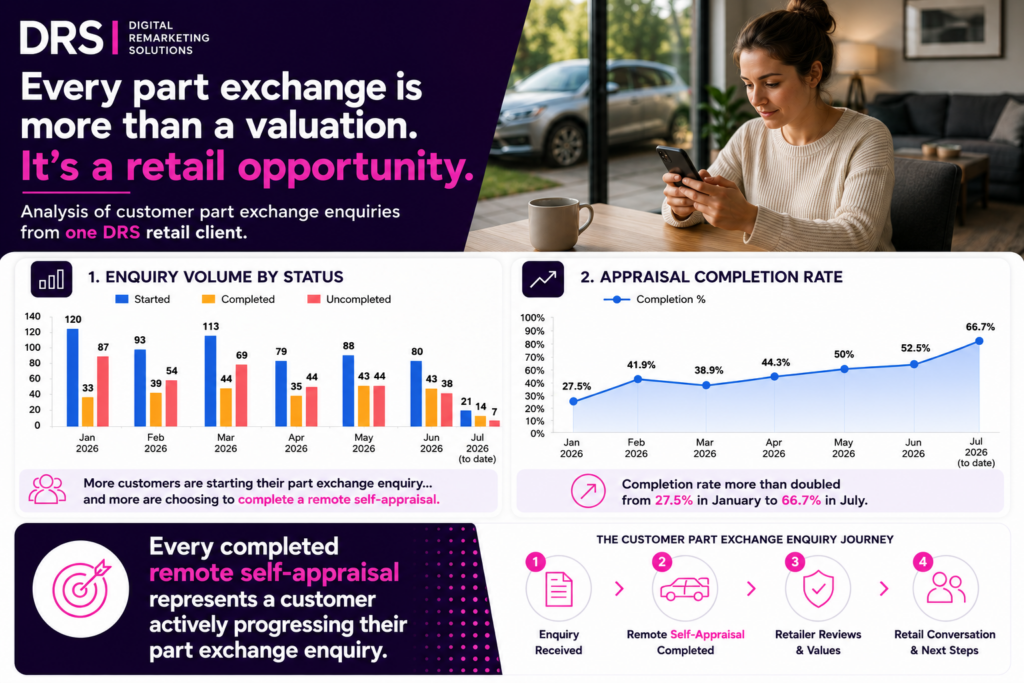
What six months of real customer behaviour revealed about engagement, confidence and retail opportunity.
When retailers review the performance of their digital part exchange process, the first metric they often look at is valuation volume.
How many valuation requests were received this month?
It’s an understandable place to start.
After all, every valuation request represents a potential retail opportunity.
But a valuation request is only the beginning of the customer’s journey.
We’ve explored this thinking before in our article Why Vehicle Valuation Alone Doesn’t Decide Modern Part Exchange and Sell My Car Journeys, where we explain why the valuation is simply the starting point of the retail acquisition journey.
The more meaningful question is:
How many customers are prepared to progress beyond the initial valuation and complete a remote self-appraisal?
That single metric can reveal far more about customer intent than valuation volume alone.
Looking beyond the valuation
Requesting an online valuation takes very little commitment.
A customer enters their registration, mileage and contact details before receiving an indicative valuation.
At this stage, both parties still have unanswered questions.
The customer may be wondering:
“Will the dealership honour this valuation when they see my vehicle?”
At the same time, the retailer is asking:
“Does the vehicle actually match the customer’s description?”
Without visibility of the vehicle’s condition, uncertainty exists on both sides.
A richer retail enquiry
A remote self-appraisal changes the quality of the conversation.
Rather than relying solely on registration details and mileage, the customer provides photographs of the vehicle and details about its condition before visiting the dealership.
This transforms a basic valuation request into a far richer retail enquiry.
Instead of simply estimating a vehicle’s value, the retailer begins assessing whether the vehicle fits their stock profile, whether the valuation is achievable and how the acquisition should be managed.
The discussion moves from “What is the car worth?” to “How should we acquire this vehicle?”
This shift is one of the reasons we believe digital appraisal should be viewed as a strategic retail capability rather than simply another website feature, a topic we explored in Has Part Exchange Quietly Become a Website Feature Instead of a Customer Service?
What six months of customer behaviour revealed
The anonymised data below represents six months of customer activity from a single DRS retail client.
Rather than focusing solely on enquiry volumes, we analysed how customers progressed through the digital part exchange journey.
Two trends became immediately apparent.
Firstly, customers continued submitting healthy numbers of digital part exchange enquiries each month.
More significantly, the proportion of customers choosing to complete a remote self-appraisal increased steadily throughout the period.
Completion rates improved from 27.5% in January to 66.7% in July.
That isn’t simply a reporting statistic.
It represents a growing number of customers choosing to invest time in providing accurate information about their vehicle before visiting the retailer.
Why completion matters
Every completed remote self-appraisal creates a better informed retail conversation.
The retailer gains greater visibility of vehicle condition before making an acquisition decision.
The customer gains confidence that their vehicle has been properly assessed and that the valuation discussion will be based on evidence rather than assumption.
Reducing uncertainty benefits both sides.
Confidence plays a significant role in whether customers continue their retail journey. In our article What Really Shapes a Customer’s Vehicle Buying Power? we explore why purchasing decisions are influenced by far more than vehicle value alone.
Retailers can make more informed acquisition decisions, while customers are more likely to arrive knowing the conversation will begin from a position of transparency.
Measuring customer progression, not just lead volume
Digital retail performance should not be judged solely by the number of valuation requests generated.
A more valuable measure is understanding how many customers actively progress through the journey.
Each completed remote self-appraisal represents a customer who has invested additional time, shared meaningful information and demonstrated genuine intent to continue their part exchange journey.
That provides retailers with better information, greater confidence and ultimately stronger acquisition decisions.
Conclusion
Every part exchange starts with a valuation.
But successful acquisition depends on far more than a number.
It depends on understanding the vehicle, reducing uncertainty and helping customers progress with confidence.
That’s why we believe every completed remote self-appraisal represents something much more valuable than another valuation request.
It represents a customer actively progressing their retail journey.
Because every part exchange is more than a valuation.
It’s a retail opportunity.
How do you measure the health of your digital part exchange process?
If your reporting focuses primarily on valuation volume, you may be measuring activity instead of progress. The real opportunity lies in understanding how customers move from valuation to acquisition confidence..
If you’d like to see how condition-led self-appraisal can support part-exchange conversion and help you retain more acquisition opportunities, we’d be happy to show you how the DRS platform works.