Why Part-Exchange Conversion Is Back in the Spotlight
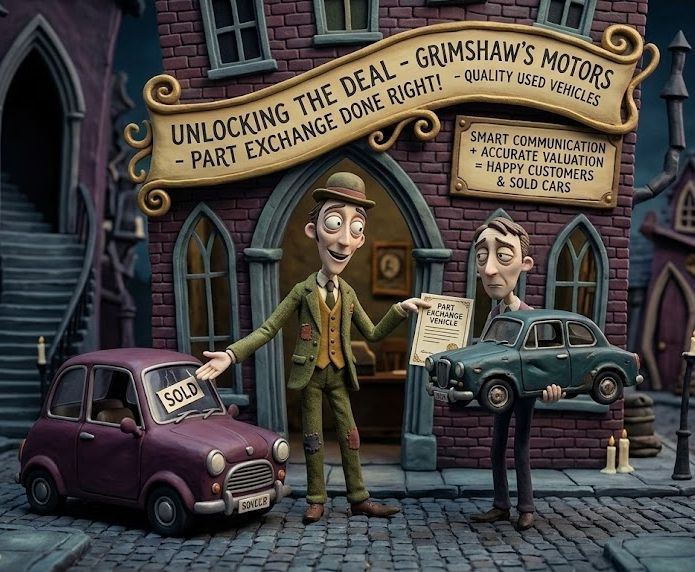
Recently, we’ve noticed a growing industry conversation around one topic that has quietly sat in the background for years — part-exchange conversion.
Consultants, operators and industry leaders are increasingly highlighting how much opportunity still exists within the PX journey, and how often it is overlooked in the rush to generate new leads.
This renewed focus isn’t coming from theory. It’s coming from real operational experience across the trade.
PX: The Underestimated Profit Engine
For many dealers, the part-exchange is still treated as a necessary step in completing a retail deal rather than a strategic acquisition channel in its own right.
Yet the economics are clear.
A successful PX delivers two outcomes:
- a retail vehicle sale
- a stock acquisition opportunity
Few other activities in the dealership create this kind of dual value.
Despite this, PX conversion is rarely measured, tracked, or optimised with the same discipline applied to lead generation or retail conversion.
Why PX Opportunities Still Stall
When we look at why PX opportunities don’t convert, the answer is rarely price alone.
More often, the challenge appears earlier in the journey.
At the initial enquiry stage:
- vehicle condition is unknown
- valuation confidence is limited
- decision-making becomes cautious
- conversations slow down or stop
When condition is unclear, certainty is low.
When certainty is low, momentum is lost.
This is the point where many potential part-exchange opportunities quietly disappear.
Some drift towards online marketplaces or car-buying services.
Others simply never progress beyond the first enquiry.
A Shift in How Dealers Are Approaching PX
Across the industry we’re beginning to see a shift in thinking.
More dealers are exploring how to:
- understand vehicle condition earlier in the journey
- move towards evidence-based valuations
- create clearer decision points sooner
- retain more acquisition opportunities upstream
This shift isn’t about replacing existing remarketing routes.
It’s about giving dealers stronger control and visibility before those routes become necessary.
From Conversation to Repeatable Process
The most interesting change is that this is no longer a theoretical discussion.
We are now seeing real examples of dealers successfully sourcing vehicles from enquiries that would historically have stalled or moved elsewhere.
The common theme across these examples is simple:
When condition is understood earlier, decision-making becomes easier for both the customer and the dealer.
And when decision-making becomes easier, conversion improves.
The Bigger Opportunity
Part-exchange has always been a powerful acquisition channel.
What’s changing now is the industry’s willingness to revisit how the process works.
As digital retail evolves and acquisition competition increases, upstream PX enquiries are becoming one of the last areas where dealers still hold significant influence over the outcome.
Which is why the conversation around PX conversion is returning — and why it’s likely to grow.
Want to explore this in your dealership?
If you’d like to see how condition-led self-appraisal can support part-exchange conversion and help you retain more acquisition opportunities, we’d be happy to show you how the DRS platform works.