Part Exchange Valuation: Why Condition and Buyer Demand Matter as Much as Market Data
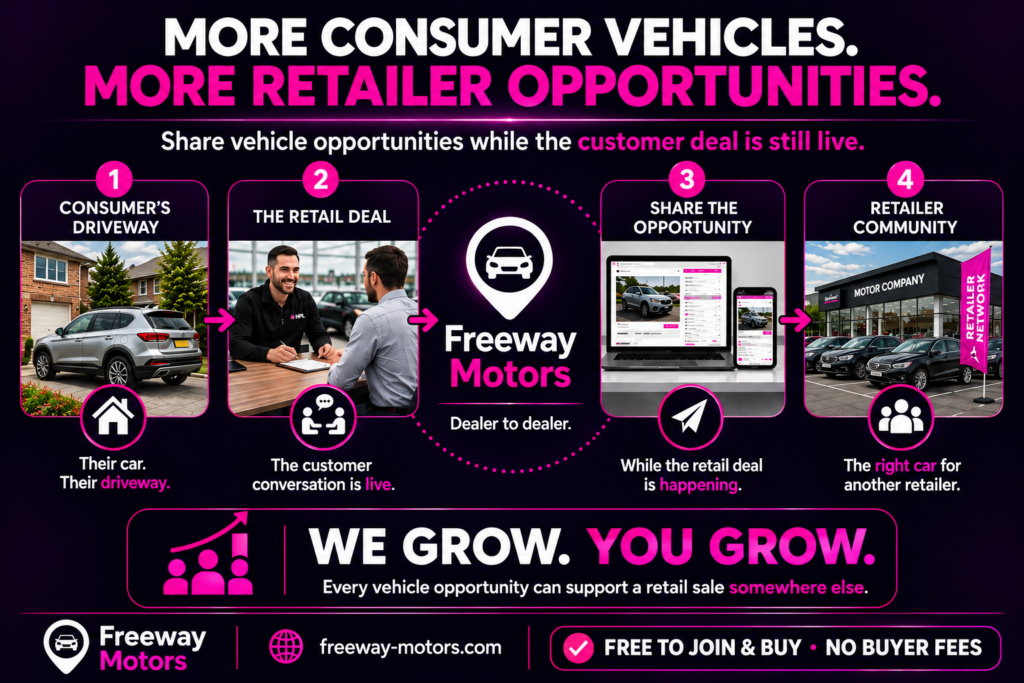
More consumer vehicles. More retailer opportunities.
Part exchange valuation has become increasingly data-driven.
Automotive retailers can access trade valuations, retail pricing, advertised vehicle data, days-to-sell information and increasingly sophisticated market insights when deciding what a consumer’s part exchange is worth.
But valuation data alone doesn’t answer the most important question:
What is this particular vehicle worth, right now, to the retailer that actually wants to buy it?
At Digital Remarketing Solutions, we believe there are three increasingly important layers to making a better vehicle acquisition decision:
Market valuation data → Actual vehicle condition → Real buyer appetite
Bringing those three together while the consumer’s retail deal is still live could change the way retailers approach both part exchange valuation and used vehicle acquisition.
Consumers increasingly arrive with their own part exchange valuation
The traditional part exchange conversation has changed.
Consumers can obtain an online car valuation before ever speaking to a dealership. They may also have received an actual purchase offer from another retailer or one of the major online car-buying services.
That means a customer can enter a new or used car enquiry with a clear expectation of what their existing vehicle is worth.
For the retailer, that can create a problem.
What happens when the consumer expects £15,000 for their part exchange, but the retailer is only comfortable acquiring it at £14,000?
That £1,000 difference isn’t simply a part exchange valuation problem.
It can become a retail sales problem.
If the customer needs £15,000 for their current vehicle to make the change affordable, failing to meet that expectation could be the difference between selling them their next car or losing the retail sale altogether.
This is why, as we explored in Why Vehicle Valuation Alone Doesn’t Decide Modern Part Exchange and Sell My Car Journeys, the valuation can become the benchmark against which the consumer judges every subsequent conversation.
A part exchange valuation is only the beginning of the decision
Vehicle valuation data is enormously valuable.
It can tell a retailer where comparable vehicles sit in the wholesale and retail markets and provide the evidence needed to establish an initial valuation.
But ultimately, valuation data is still providing information about vehicles like this one.
The retailer has another question to answer:
What is this actual vehicle worth?
That’s where vehicle condition becomes important.
Two cars of the same make, model, derivative, age and mileage can present very different acquisition propositions.
One may require significant cosmetic preparation.
The other may be exceptionally clean and virtually retail-ready.
Yet before the vehicle has been physically inspected, those differences may not be adequately represented by conventional valuation data.
We’ve looked specifically at how vehicle condition changes part exchange valuations, because understanding condition earlier can materially change the retailer’s acquisition, preparation and routing decision.
That’s why we believe the next evolution of digital part exchange needs to combine valuation data with actual vehicle condition information.
Remote vehicle appraisal brings condition into the online part exchange journey
With a structured remote vehicle appraisal, the consumer can provide information and images of their vehicle before visiting the dealership.
Rather than asking a consumer simply to select whether their vehicle is poor, average, good or excellent, retailers can gain much greater visibility of the actual vehicle being offered in part exchange.
Through DRS Remote Appraisal, the consumer can complete a guided self-appraisal remotely using their smartphone.
This creates structured vehicle information and condition imagery that can be reviewed by the retailer as part of the customer’s existing enquiry.
The objective isn’t to replace a professional physical appraisal.
It’s to give the retailer better information earlier in the buying journey.
Condition first. Decision second.
But even condition doesn’t necessarily complete the acquisition decision.
There is another variable.
The same part exchange can be worth different amounts to different retailers
Every automotive retailer has a different used vehicle stock profile.
One retailer may specialise in prestige vehicles.
Another may predominantly retail vehicles below £15,000.
A franchised retailer may have different age or mileage parameters from a large independent used car supermarket.
As a result, two retailers can look at exactly the same part exchange and legitimately arrive at different acquisition values.
For one business, the vehicle may simply be unwanted part exchange stock that needs to be disposed of.
For another, it could be:
Exactly the make, model, age, mileage, specification and price point they want for their retail forecourt.
And that changes the economics.
The first retailer may value the vehicle according to what it believes it can recover through a subsequent trade disposal.
The second retailer can potentially value it according to its retail opportunity.
That’s why buyer appetite represents another important layer in part exchange valuation.
Market data tells you what vehicles like this are worth.
Condition helps establish what this particular vehicle is worth.
The next trade buyer determines what this particular vehicle is worth to them.
What if you could find that buyer while the customer’s deal was still live?
This is where Freeway Motors changes the traditional sequence.
Historically, the journey might look something like this:
Consumer enquiry → Part exchange valuation → Retail deal → Vehicle taken into stock → Disposal decision → Trade buyer
But why does the trade buyer necessarily have to come at the end?
Once a consumer has completed a remote vehicle appraisal, the retailer already has structured information and condition images available.
If the vehicle doesn’t fit its own retail stock profile, the opportunity can potentially be shared with another retailer while the originating customer conversation is still live.
The journey becomes:
Consumer enquiry → Remote appraisal → Part exchange decision → Share opportunity → Retailer buyer
And all of that can happen while the originating retailer is still trying to sell the consumer their next vehicle.
This builds on something we’ve previously explored in DRS Insights: every part-exchange enquiry has value — the real question is what happens next. The vehicle opportunity exists while the customer conversation is still active; the opportunity is to decide where that vehicle should go before the deal is complete.
Finding the next buyer could help you sell the next car
This is perhaps the most important part of the Freeway Motors proposition.
The objective isn’t simply to create another way of disposing of part exchange vehicles.
It’s about helping retailers make better retail and acquisition decisions.
Imagine a consumer has already received a strong valuation elsewhere.
Your own valuation data suggests the consumer’s expectation is at the upper end of the market.
You’ve reviewed the remote appraisal and understand the vehicle’s condition.
But it isn’t a car you particularly want for your own retail stock.
Traditionally, you have a decision to make.
Do you stretch your part exchange valuation to secure the retail sale and accept the subsequent disposal risk?
Or hold your valuation and potentially lose the customer?
There could be a third option:
Find the retailer that actually wants the vehicle.
If another retailer has a stronger buying appetite because the vehicle fits its retail stock profile, its acquisition value may help support the part exchange figure required to conclude the originating retail deal.
That’s an important distinction.
The objective isn’t simply to sell the part exchange.
It’s to help sell the next car.
From part exchange disposal to live vehicle acquisition
There is also a wider opportunity here for the automotive retail sector.
Thousands of consumer-owned vehicles enter retailer conversations every day.
Many eventually become part exchanges.
Some will be retained and retailed by the acquiring dealership.
Others will move through traditional wholesale and auction channels before eventually arriving with another retailer.
But the potential retail opportunity existed much earlier.
It existed when the vehicle was still sitting on the consumer’s driveway.
If retailers can capture the vehicle’s condition remotely and connect that opportunity with other retailers earlier, we can potentially shorten that journey.
Instead of waiting for:
Consumer → Retailer → Physical stock → Wholesale → Another retailer
we can create the possibility of:
Consumer → Retail deal → Retailer-to-retailer opportunity
That is the thinking behind Freeway Motors.
One retailer’s unwanted part exchange could be another retailer’s ideal used car
Used car stock acquisition remains one of the biggest challenges facing automotive retailers.
But at exactly the same time, retailers throughout the country are receiving consumer part exchange enquiries containing vehicles they don’t necessarily want themselves.
Those two things shouldn’t exist independently.
Freeway Motors is designed to connect them.
A retailer can expose a consumer vehicle opportunity to a community of other automotive retailers.
The potential buyer can review the vehicle information and consumer-provided appraisal images online before deciding whether the vehicle is of interest.
The originating retailer remains in control of what happens next.
Dealer to dealer.
More consumer vehicles. More retailer opportunities.
This is where the network becomes increasingly valuable.
More retailers sharing suitable consumer vehicle opportunities creates more potential used car stock for the community.
More retailers buying through the network creates more potential destinations for the vehicles being offered.
And greater buyer diversity increases the possibility of finding a retailer whose particular stock profile matches a vehicle another retailer doesn’t want.
That’s the network effect we’re trying to create:
We grow. You grow.
Every vehicle opportunity has the potential to support a retail sale somewhere else.
Free to join and buy. No buyer fees.
Freeway Motors is free for automotive retailers to join and buy through, with no buyer fees.
Retailers can review available vehicle opportunities, examine the vehicle information and consumer-provided appraisal images, and decide whether an opportunity fits their own used vehicle stock profile.
Already registered retailers can continue using their existing Freeway Motors login details.
View current vehicle opportunities on Freeway Motors
Turn your own consumer enquiries into vehicle opportunities
For retailers using DRS Remote Appraisal, Freeway Motors provides an additional potential route for the vehicle information captured during a consumer part exchange or Sell My Car enquiry.
Instead of asking only:
“What is this customer’s vehicle worth to us?”
retailers can potentially ask:
“What is this vehicle worth to the retailer that wants it next?”
That moves digital part exchange beyond simply producing another valuation.
It combines:
Valuation data.
Vehicle condition.
Real retailer demand.
And potentially gives the originating retailer another way to bridge consumer part exchange expectations and sell the next car.