What Marketplace Seller Fees Mean For Dealer Part-Exchange Strategy
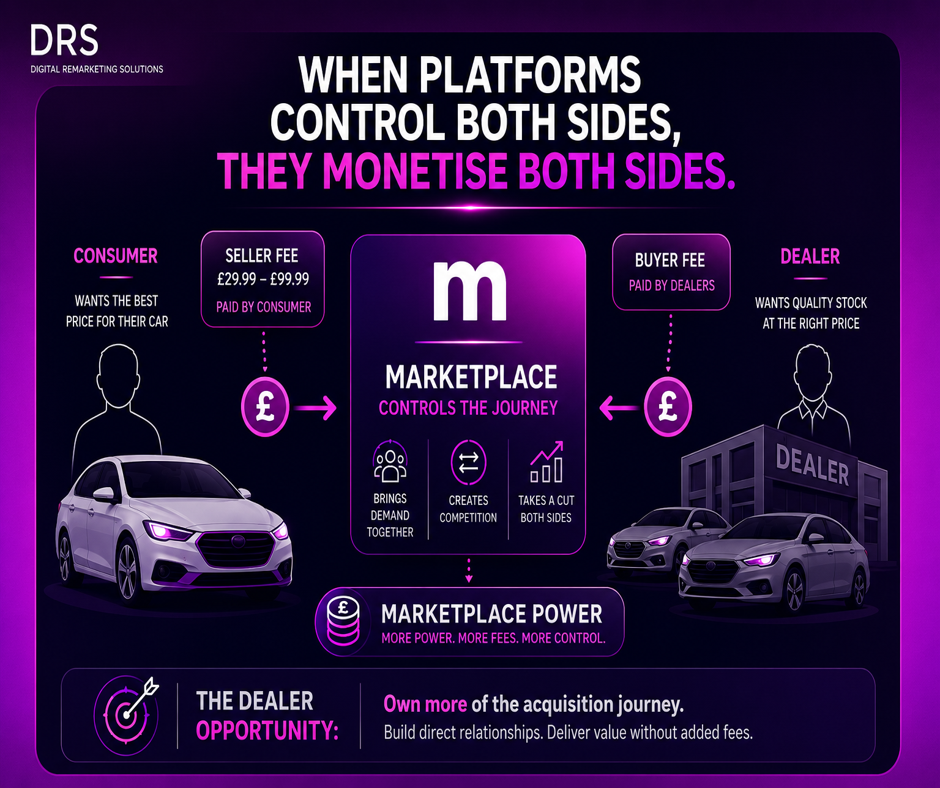
The introduction of seller fees by Motorway is an interesting moment for the automotive sector.
Not because seller fees themselves are unusual.
But because it reflects something much bigger happening across automotive retail:
What begins as a consumer-friendly marketplace often evolves into a fully monetised ecosystem once it controls both sides of the transaction.
Dealers fund the platform. Consumers now fund the platform too.
We have seen similar patterns before across automotive retail and classified marketplaces.
To be clear, this is not criticism of Motorway.
They identified a genuine consumer demand and built significant scale around it. Consumers clearly value convenience, speed and competitive bidding environments when selling vehicles.
But the move does raise an important strategic question for dealers:
How Much Of The Part-Exchange Journey Should Dealers Control Themselves?
For years, many dealers have gradually outsourced more of the vehicle acquisition journey to third-party marketplaces.
In some cases, understandably so.
Marketplaces offer:
- Huge consumer reach
- Strong marketing power
- Large dealer networks
- Convenience
- And established consumer trust
But as marketplaces scale, pricing power naturally shifts towards the platform.
The more dependent the market becomes on third-party ecosystems, the more influence those platforms gain over:
- Customer acquisition
- Transaction flow
- Fees
- Dealer visibility
- And ultimately margin.
That does not make marketplaces bad.
It simply changes the commercial dynamics.
The Dealer Opportunity Going Forward
The more interesting question is not whether marketplaces will continue to grow.
They almost certainly will.
The more important question is:
What do dealers need to do if they want to retain greater control of the part-exchange journey themselves?
Increasingly, that may mean offering consumers:
- A direct relationship
- A free-to-consumer appraisal experience
- Earlier condition-led conversations
- Smoother part-exchange processes
- And stronger downstream routing for non-core stock.
Historically, many part-exchange conversations have started with a headline valuation before the actual condition of the vehicle has properly been established.
That often creates friction later in the journey.
Consumers can have expectations set around headline figures before the full condition of the vehicle has properly been established. Dealers then become exposed to revaluation conversations. Collection costs increase. Trust can weaken. And the customer journey becomes harder to control.
Why Condition Matters Earlier In The Journey
As online acquisition continues to evolve, condition-led conversations are likely to become increasingly important.
Not to reduce valuations. But to improve certainty, transparency and transaction quality for both dealer and consumer.
A valuation based on the actual condition of the vehicle often creates:
- Stronger expectation setting
- Smoother negotiations
- Improved conversion quality
- Fewer surprises at collection
- And more confidence for both dealer and consumer.
This is where dealer-controlled digital appraisal journeys can become strategically important.
Rather than waiting until late in the process to understand the vehicle properly, dealers have the opportunity to introduce condition earlier in the customer journey.
That changes the nature of the conversation.
Instead of simply competing on headline numbers, the discussion becomes more focused on:
- Transparency
- Certainty
- Convenience
- And completing the transaction successfully.
The Importance Of Downstream Vehicle Routing
Another key challenge for dealers is what happens after the vehicle has been appraised.
Not every part exchange fits a dealer’s retail profile.
Some vehicles may:
- Fall outside age parameters
- Sit outside mileage profiles
- Not suit local demand
- Or require disposal into wider trade networks.
As acquisition pressure increases, dealers may increasingly need stronger downstream disposal routes alongside their consumer acquisition strategy.
But importantly, those conversations may need to happen much earlier in the journey — while the retail deal is still live and while the vehicle is still sitting on the consumer’s driveway.
Historically, many disposal decisions have happened too late in the process.
By introducing upstream condition-led conversations earlier, dealers potentially create the opportunity to:
- Assess retail suitability sooner
- Identify non-core stock earlier
- Involve buyers or trade routes upstream
- Reduce late-stage friction
- And retain greater control of both the transaction and customer journey.
That could include:
- Internal trade networks
- Direct-to-trade disposal
- Buyer groups
- Or wider remarketing channels.
The important point is that dealers retain greater control over where the vehicle goes next, rather than automatically surrendering the customer journey to a third-party marketplace.
The opportunity is not simply about appraising vehicles earlier.
It is about creating more connected upstream and downstream conversations during the active deal-making phase, before the vehicle ever leaves the consumer’s driveway.
The Market Is Evolving
The future is unlikely to become:
Marketplaces OR dealer-controlled acquisition.
Both models will continue to exist.
But the market is evolving.
And as marketplaces become more commercially mature, dealers may increasingly evaluate:
- Which parts of the customer journey they want to own directly
- And which parts they are comfortable outsourcing.
For progressive dealers, the opportunity may not simply be about generating more valuations.
It may be about creating stronger, more transparent and more controllable part-exchange journeys from the very beginning.
That is where long-term customer retention, acquisition control and margin protection may increasingly sit.
DRS helps dealers introduce condition-led conversations earlier in the part-exchange journey through remote self-appraisal technology, helping create more transparent and controllable vehicle acquisition processes.
Alongside remote appraisal technology, DRS has also developed a number of downstream vehicle routing solutions designed to help dealers retain greater control of the disposal journey.
This includes Freeway Motors, a dealer-managed trade disposal platform that enables vehicles to be routed into wider trade networks while the dealer retains greater control of both the customer relationship and the downstream disposal journey.
The objective is not simply to generate more valuations.
It is to help dealers create more connected, transparent and controllable part-exchange ecosystems from acquisition through to disposal.
It’s an area we’re working closely on with dealers — and always happy to discuss what’s working in practice.