A Decade of Change in the Automotive Customer Journey — What’s Been Solved and What Still Needs Work
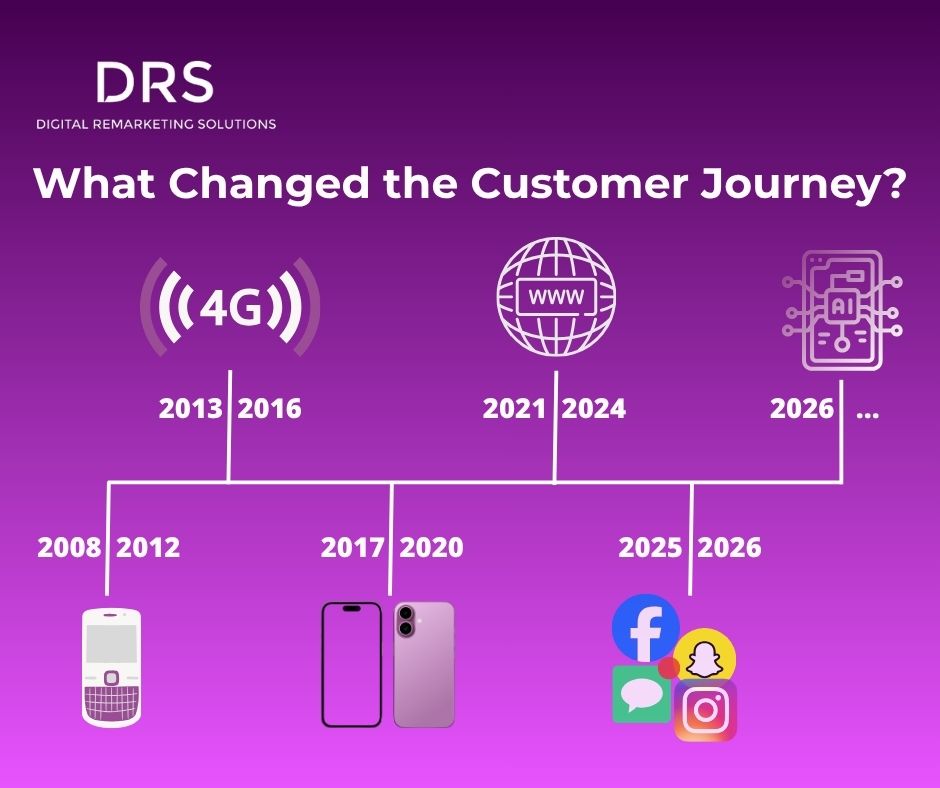
Over the past decade, the automotive customer journey has changed significantly.
Back in 2017, “online retailing” was gaining real traction — not because it was new, but because the technology had finally caught up.
Between roughly 2013 and 2016, the widespread adoption of smartphones, app-based experiences, and 4G connectivity fundamentally changed how consumers interacted with the internet.
What was once slow, fragmented, and desktop-based became fast, always-on, and mobile-first.
At that point, the industry began focusing on a new challenge:
How do you enable a customer to buy a car without being physically present?
That question defined the next phase of the journey.
What’s Changed
Fast forward to today, and much of that challenge has been addressed.
Stock is richer, with better imagery, video, and descriptions.
Finance tools allow customers to understand affordability instantly.
Digital journeys are more connected, allowing customers to move between online and showroom with far less friction.
And now AI is accelerating this even further — helping customers access information, ask questions, and engage earlier in the journey.
In many ways, the industry has delivered on what it set out to do.
The journey is faster.
More accessible.
More flexible.
What We’ve Learned
But stepping back, it’s clear the car buying journey was never just about buying a car.
For most customers, it’s a combined transaction:
Buying one vehicle while selling another.
For the retailer, that exchange isn’t just about making a deal work in the moment — it also plays a role in how future stock is acquired and how the next retail opportunity is created.
Where Alignment Matters
Over time, it’s become clear that the journey only really works when three things align at the same time:
- The customer finds the right car
- They understand the monthly commitment
- They feel comfortable with the value of their current vehicle
This is the moment customers move from browsing into what could be described as “buying mode.”
Where the Journey Still Evolves
The first two areas have seen significant progress over the last decade.
The third is still evolving.
The market has responded in interesting ways.
Third-party car buying platforms have helped customers achieve more competitive values for their vehicles — increasing confidence around price.
But in doing so, the journey has often become more fragmented, with customers managing separate “buy” and “sell” processes.
A Behavioural Perspective
This can also be viewed through the lens of behavioural science.
The Fogg Behaviour Model suggests that behaviour happens when Motivation, Ability, and Trigger occur at the same time.
Looking at today’s journey:
- Motivation is strong — customers are more informed than ever
- Triggers are increasing — particularly with AI supporting early engagement
- But Ability can still vary across the process
Where there is uncertainty, behaviour slows.
Where AI Fits
AI will continue to improve the front end of the journey.
It will make interactions faster, more responsive, and more engaging.
But like any technology, it builds on the structure that already exists.
What Comes Next
The last decade has been about making the journey digital.
The next may be about making it fully aligned.
Because when every part of the process supports the same outcome, customers don’t need to be persuaded — they’re already ready to move.
Closing Thought
As the journey continues to evolve, the focus is shifting from simply digitising individual steps to ensuring those steps connect in a way that builds confidence throughout the process.
For retailers, that means thinking not just about how to capture demand — but how to support it all the way through to a completed transaction, with clarity, consistency, and control.
As the journey continues to evolve, the way part-exchange is captured and managed earlier in the process is becoming increasingly important.
It’s an area we’re working closely on with dealers — and always happy to discuss what’s working in practice.