Why Condition Changes Value in Part-Exchange Decisions
How Vehicle Condition Affects Part Exchange Valuations
When dealers calculate a part exchange valuation, vehicle condition is one of the most important factors influencing the final price.
A part exchange valuation is rarely just about the model or mileage — the true value often depends on the vehicle’s real condition once properly assessed.
Dealers often see situations where a customer later sells their car privately or through an online buying platform for more than the part-exchange figure they were offered.
On the surface, it can appear that the dealer has missed out on the vehicle.
But that assumption doesn’t always tell the full story.
In many cases, the difference comes down to one simple factor:
Condition.
When the dealer sees the vehicle first
Imagine a typical scenario.
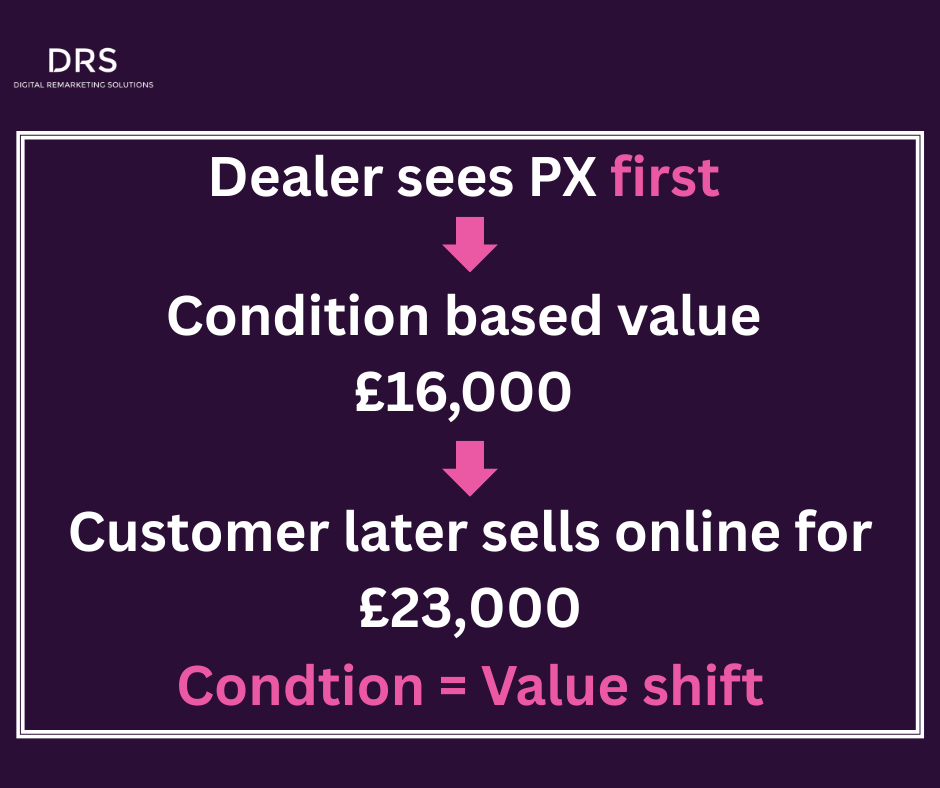
A dealer assesses a part-exchange vehicle during the deal process and provides a condition-based valuation of £16,000.
That valuation reflects what the dealer can see at that moment:
- cosmetic damage
- refurbishment requirements
- preparation costs
- mechanical risks
- time and margin considerations
The dealer isn’t simply quoting a number.
They are making a commercial decision based on the real condition of the vehicle.
The vehicle later sells online for £23,000
Some time later the customer manages to sell the vehicle online for £23,000.
At first glance it might appear the dealer missed an opportunity.
But the reality is that the online buyer may have been working with different assumptions:
- unseen condition
- optimistic grading
- limited inspection
- or a different retail model
Those factors can significantly influence the price someone is willing to offer.
Disciplined buying vs blind buying
From the dealer’s perspective, making a disciplined valuation based on real condition is often the smarter decision.
Buying blind, or stretching beyond what the condition justifies, can quickly erode margin once preparation work begins.
Dealers know that a vehicle can look very different once it arrives on site and goes through inspection and reconditioning.
Which is why understanding condition early is so important.
Why the order of the conversation matters
In today’s market, the order of the conversation matters more than ever.
When condition is understood early in the appraisal process, dealers can make clearer decisions about:
- whether to retail the vehicle
- whether to trade it
- or whether to step away entirely
That clarity protects margin and reduces risk.
Dealers who understand condition early can make better decisions about whether to retail, trade, or remarket a part exchange vehicle.
Condition changes value
The difference between two valuations is not always about who was willing to pay more.
Often it simply reflects different levels of information about the vehicle.
One decision may be based on assumption.
The other is based on condition.
And ultimately:
Condition changes value.
Looking at the bigger opportunity
Understanding vehicle condition is only part of the process. The bigger opportunity for dealers is how part-exchange enquiries are handled while the customer conversation is still live.
Every part-exchange enquiry represents a potential vehicle entering the market, and capturing the right information early allows dealers to make better decisions about acquisition, pricing, and remarketing routes.
Want to explore this in your dealership?
If you’d like to see how condition-led self-appraisal can support part-exchange conversion and help you retain more acquisition opportunities, we’d be happy to show you how the DRS platform works.